

Facelift — rhytidectomy
A facelift is an aesthetic surgical procedure that rejuvenates the face by removing excess skin and tightening the deeper facial structures. Results last 10 to 15 years.
No, the essence of a facelift is not just tightening the skin — a true facelift acts on the deeper facial structures, which are responsible for the support and shape of the face.
The ageing process — what a facelift achieves
To understand how a facelift works and why the face ages in a particular way, we need to understand the internal anatomy of the face. The face is not just skin — it is a complex structure in which each layer plays its part in shaping our appearance.
As we age, changes occur in the skin, fat pads, muscles, ligaments and bones. This process is not simple, because all these layers interact and the loss of supporting structures in one layer affects all the others.
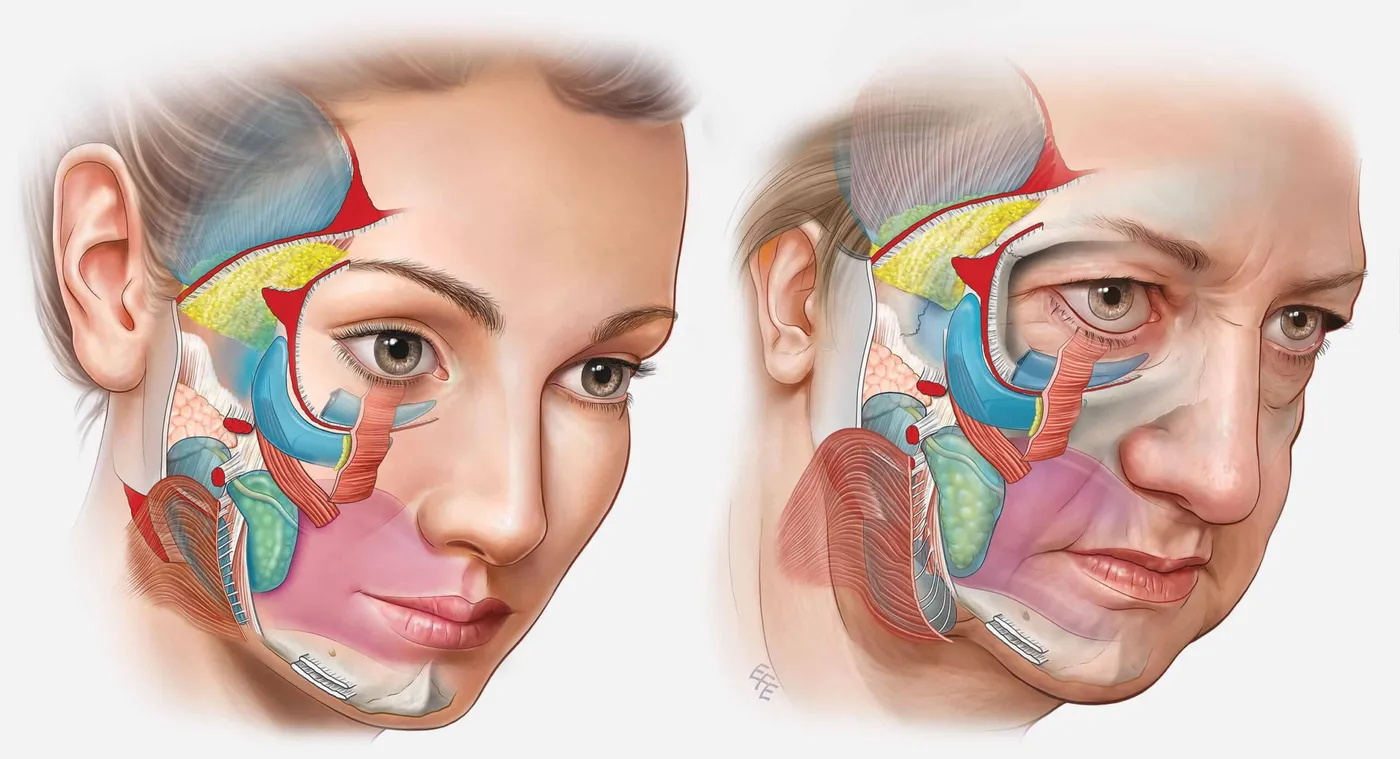
What are the facial ligaments and why do they matter?
Ligaments are strong, elastic bands of connective tissue that connect and anchor the skin and muscles to the deeper structures, primarily the bone and fascia. We can think of them as anchors or ropes that hold the skin and subcutaneous tissue in place, allowing the face to keep its youthful tension and shape.
While we are young, the ligaments are firm and elastic. Over time the ligaments loosen, which causes:
- Descent of the soft tissues — the cheekbones and cheeks lose their full, lifted appearance and begin to fall downwards.
- The formation of wrinkles and folds — as the tissue descends, the skin "folds", leading to more pronounced nasolabial folds and marionette lines.
- Loss of a defined jawline — the fat that sat higher on the cheeks moves downwards, creating sagging skin at the jaw (known as jowls).
What is the SMAS layer and why is it key to a facelift?
The SMAS (Superficial Musculoaponeurotic System) is a layer of connective and muscle tissue located beneath the skin and subcutaneous fat, and above the deeper facial muscles. It plays a key role in the structural support of the face by connecting the muscles to the skin and allowing them to work together in facial expression.
As we age, the SMAS layer stretches and loosens along with the ligaments. This is one of the main reasons why tightening the skin alone cannot give a lasting result — because it is the SMAS layer that actually holds the skin in place.
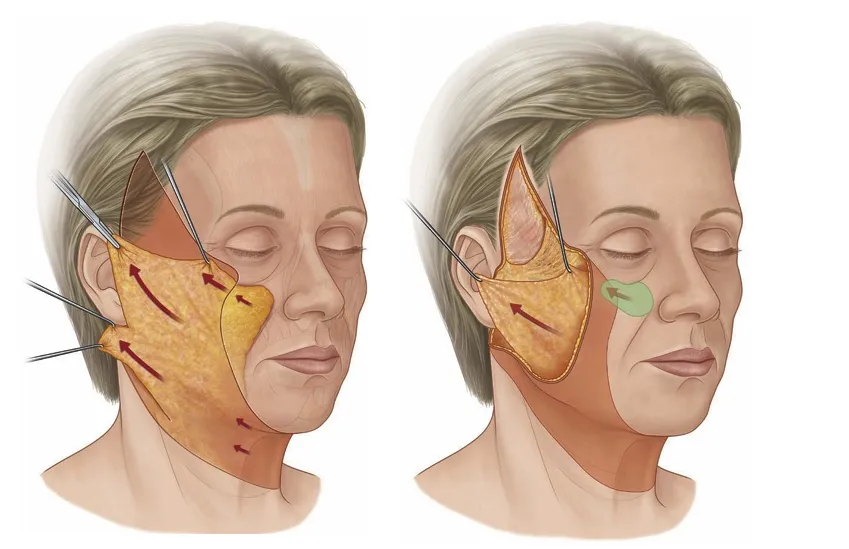
Tightening the deeper layers, not just the skin.
Skin is a structure that naturally stretches very quickly — if we tightened only the skin, the underlying structures would soon stretch it again and all the folds would return. That is why, during the procedure:
The surgeon lifts and repositions the deeper tissue layers to their natural position.
This ensures a lasting, natural result, unlike older methods that gave a "tight" look.
The cheeks lift, the jawline becomes more defined, and the neck looks tighter.
Which one is right for you?
1. Mini facelift
A mini facelift is a less invasive variant of the traditional facelift and is ideal for patients with early signs of ageing. It targets the lower face, including mild sagging of the cheeks and jaw. It is performed through smaller incisions than a classic facelift, allowing a faster recovery.
2. SMAS (classic) facelift
The SMAS facelift is the most commonly performed traditional facelift technique. It provides long-lasting results by tightening the deeper layers of muscle and connective tissue while lifting the skin. It improves the facial contours, removes excess skin and achieves a natural, rejuvenated look that lasts for years.
3. Deep plane facelift
This rejuvenation technique goes deeper into the facial layers, focusing on the muscle structures beneath the SMAS layer. It provides longer-lasting, more pronounced results with a minimal risk of a "tight" look. The procedure moves the facial layers into a more natural position, ensuring a lasting and harmonious result.
How to choose the right facelift for you?
The choice of facelift depends on your age, the degree of skin laxity and the desired results. If you want subtle rejuvenation, a mini facelift or a non-surgical approach can be an excellent option. For more significant changes, a classic or deep plane facelift will provide lasting results.
When making the decision, it is important to consider your personal aesthetic goals, your preference for minimally invasive procedures and your readiness for the recovery time. If you are torn between a surgical and a non-surgical approach, read our guide Facelift vs. fillers and wrinkle treatments — what to choose? (in Croatian), and a facelift is often combined with blepharoplasty for complete rejuvenation.
What the whole process looks like.
1. Consultation and planning
A detailed conversation with the patient: we analyse the face, assess the degree of skin laxity, the state of the SMAS layer and ligaments, and define the goals of the procedure. We sometimes recommend combining it with other treatments, such as blepharoplasty or lipofilling (transferring your own fat to the face).
2. Preparing for the procedure
The patient receives detailed preparation instructions, including avoiding certain medications that can increase the risk of bleeding (such as aspirin) and stopping smoking, as it can slow healing.
3. Anaesthesia and the start of surgery
A facelift is most often performed under general anaesthesia or deep sedation. The incisions are carefully placed — usually along the hairline and around the ear — so they are as inconspicuous as possible after healing.
4. Tightening the deeper structures
The key part of a facelift is working on the SMAS layer, which is lifted and repositioned to achieve a lasting, natural result. Simply removing excess skin without addressing the SMAS would not give lasting results, as the skin would quickly sag again.
5. Closing the incisions and the final stage
Once the tissues are precisely positioned, the excess skin is removed and the incisions closed with fine sutures. If needed, small drains are placed to reduce fluid build-up and swelling.
6. Recovery and results
The patient is monitored for a few hours or, if necessary, overnight. Swelling, bruising and mild discomfort are possible in the first days. The most pronounced swelling subsides within two to three weeks, while the full results are seen after a few months. The scars are discreetly placed and become barely visible over time.
10 to 15 years of a younger look.
Facelift results last 10 to 15 years, and proper skin care, avoiding the sun and a healthy lifestyle help maintain a fresh appearance.
We often combine it with fillers, myomodulators and biostimulators for a complete transformation.
Medically reviewed by: Dr. Zoran Kranjčec, subspecialist in head and neck plastic surgery · Content last reviewed:
Book a consultation →
Facelift — patients' common questions.
How long does facelift surgery take?
Depending on the technique and extent, a facelift takes between 2 and 5 hours. It is performed under general anaesthesia or deep sedation, and the patient is monitored for a few hours or overnight.
How long do facelift results last?
Facelift results last 10 to 15 years, because the deeper facial structures (the SMAS layer and ligaments) are tightened, not just the skin. A healthy lifestyle and sun protection extend the effect.
What is the difference between a mini, SMAS and deep plane facelift?
A mini facelift targets the lower face through smaller incisions and is ideal for early signs of ageing. A SMAS (classic) facelift tightens the deeper layers of muscle and connective tissue for a lasting result. A deep plane facelift goes beneath the SMAS layer and gives the most pronounced and longest-lasting results for more severe facial sagging.
Will I look "tight" and unnatural after a facelift?
No — that is exactly why we work on the deeper structures, not just the skin. The goal is a rested, fresher version of you: the cheeks lift, the jawline becomes more defined, and facial expression stays natural.
What is recovery after a facelift like?
Swelling and bruising are common in the first days. The most pronounced swelling subsides over two to three weeks, when most patients return to social activities, and the full result is visible after a few months.
Are fillers and wrinkle treatments an alternative to a facelift?
For early signs of ageing, myomodulators, fillers and biostimulators can give a lovely refresh. For more pronounced sagging of the skin and tissue, only a facelift gives a structural and lasting change — and non-surgical treatments are an excellent complement to the result.
It's time for a fresher reflection in the mirror
200+ facelifts performed. Tel. +385 23 324 881
Book a consultation →